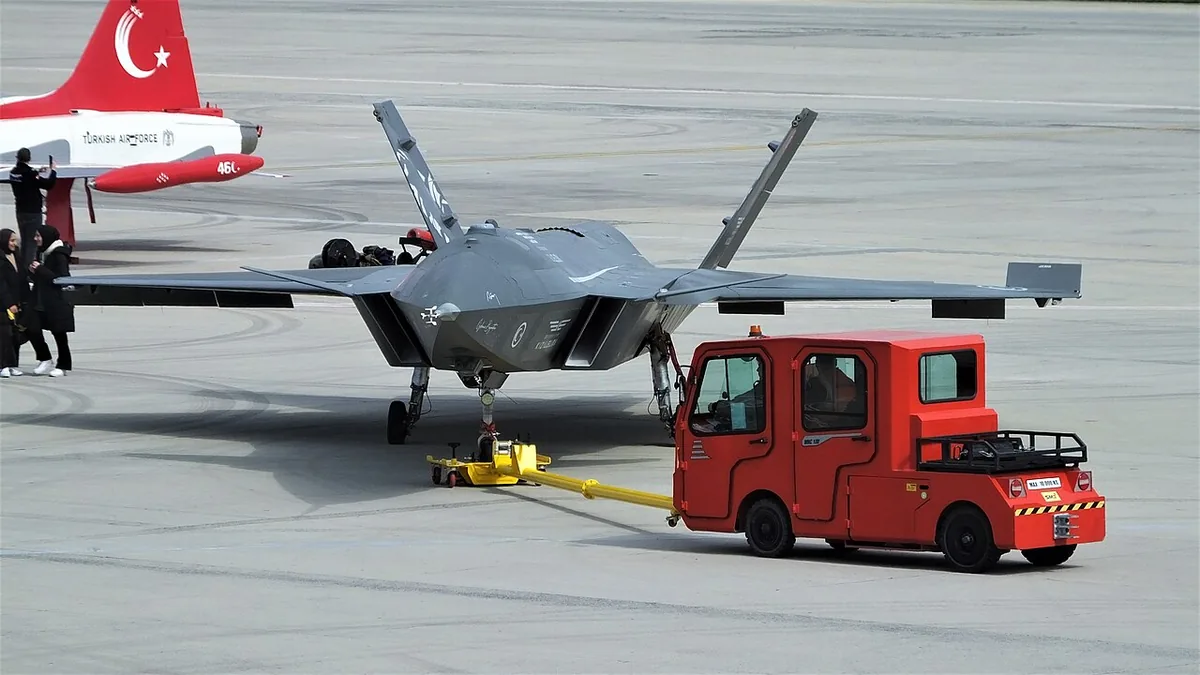
KIZILELMA is Baykar’s turbofan-powered unmanned combat-aircraft programme, separate from its propeller-driven long-endurance families. The company describes multiple configurations and continued work on carrier operation. Current dimensions and mass describe today’s published family record; they are not retrospectively assigned to the original prototype or treated as independently measured results for every aircraft.[6]
Published manufacturer figures describe the stated configuration. They are not independently verified performance results; variants and operating conditions can differ.
Baykar’s November 2021 announcement identifies AI-450 engines on AKINCI and agreements with Ivchenko-Progress for AI-322F supply and AI-25TLT integration for MİUS, later named KIZILELMA. A Motor Sich MS500 agreement concerned an alternative under development. The contracts do not establish identical engines or completed deliveries across all aircraft.[221]
Documented recordReported test; not general service acceptance
ASELSAN’s November 2025 newsletter dates AKINCI’s first integrated MURAD flight to February 2025 and KIZILELMA’s to October 2025. The month-level dates are retained. Radar flights establish an integration stage; they do not by themselves establish operational acceptance of every aircraft or all advertised radar modes.[226]
Documented recordReported test; not general service acceptance
Baykar reports that prototype PT3 tested TOLUN and TEBER-82 on 8 October 2025. The release describes production progress and a target for inventory entry; a firing test or planned entry date is distinct from a documented armed-forces handover.[238]
The 19 November KIZILELMA trial used MURAD tracking and a simulated GÖKDOĞAN engagement against an F-16. Baykar explicitly describes simulated electronic firing. No live missile was fired at the F-16 in this event.[239]
Documented recordReported test; not general service acceptance
A separate Baykar report dates a live GÖKDOĞAN firing, guided using MURAD, to 29 November 2025. It describes destruction of a jet-powered test target. This corrects any reading of the earlier simulated F-16 event as a live engagement, while remaining a manufacturer-reported test rather than combat evidence.[240]
Documented recordReported test; not general service acceptance
Baykar’s July 2026 release describes S2 internal-bay tests with TEBER-82 on 25 July and TOLUN on 28 July. Calling S2 a serial-production model does not establish the number of accepted military aircraft. The catalogue retains the dated test while keeping fleet handover and quantities unconfirmed.[13]
Documented recordReported test; not general service acceptance
Baykar reports an autonomous formation flight by prototypes PT3 and PT5 on 27 December 2025. The event is a specific autonomy demonstration, not a delivered-fleet count or proof that a full operational swarm capability has been accepted.[241]
Baykar dates the original first flight to 14 December 2022. Its September 2024 release separately records PT-3’s production-prototype flight on 25 September. The two dates refer to different aircraft and development stages, not conflicting dates for the same first flight.[12]
A 30 July 2026 release describes integration tests on 25 and 28 July with S2, called a serial-production model, while explicitly discussing continued development. The latest selected event date is therefore 28 July. This source does not establish military acceptance, fleet-wide readiness or completed carrier qualification.[13]
Versions & programme scope
The page lists KIZILELMA-A, B, CA, CB and D. These labels are retained without unsupported delivery dates or an assumption of equal maturity. The configuration list and the dated PT-3/S2 records describe different aspects of the programme.[6][12][13]
Agreement announced; completion not establishedDocumented record
12 aircraft initially; delivery start targeted for 2028
Not established in selected sources
Baykar’s own announcement specifies twelve aircraft with deliveries starting in 2028. This is a future-delivery agreement, not evidence of aircraft already delivered or operational.[199][200]
A 30 July release reports tests on 25 and 28 July using S2, described as a serial-production model. The report documents continuing development; it is not an inventory-acceptance notice.[13]
Technology and testing
KIZILELMA autonomous formation test
Baykar reports a formation demonstration by PT3 and PT5 prototypes.[241]
Technology and testing
KIZILELMA live firing against jet target
Baykar reports a separate GÖKDOĞAN test against a jet-powered target using MURAD.[240]
Technology and testing
KIZILELMA simulated F-16 engagement
MURAD tracking supports simulated electronic firing; no live missile is fired at the F-16.[239]
Technology and testing
KIZILELMA first air-to-ground firing tests
Baykar reports PT3 tests with TOLUN and TEBER-82.[238]
Flight milestone
KIZILELMA first flight
Baykar’s September 2024 release retrospectively records the programme’s original first flight on 14 December 2022, separately from PT-3’s 2024 production-prototype flight.[12]